
Introduction
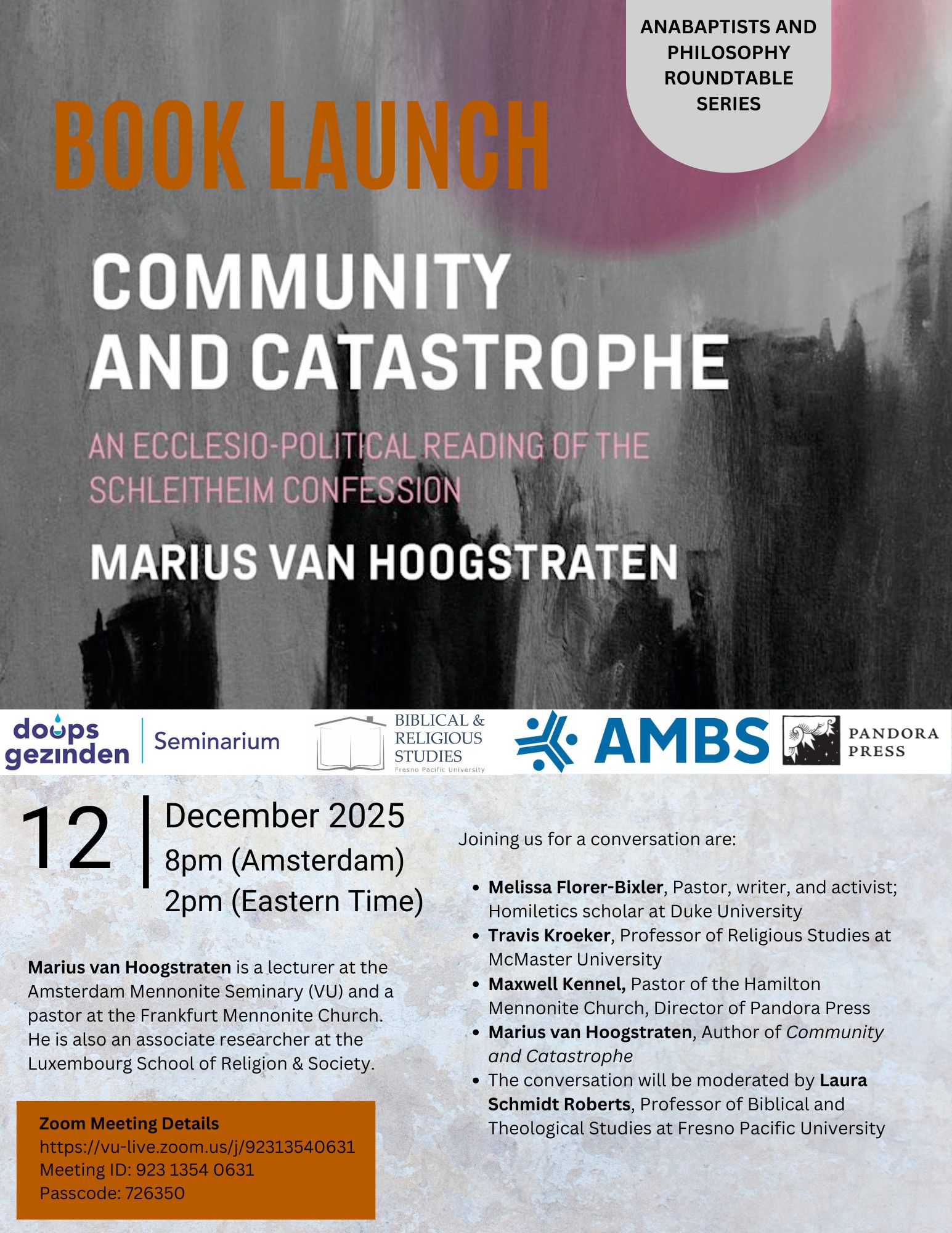
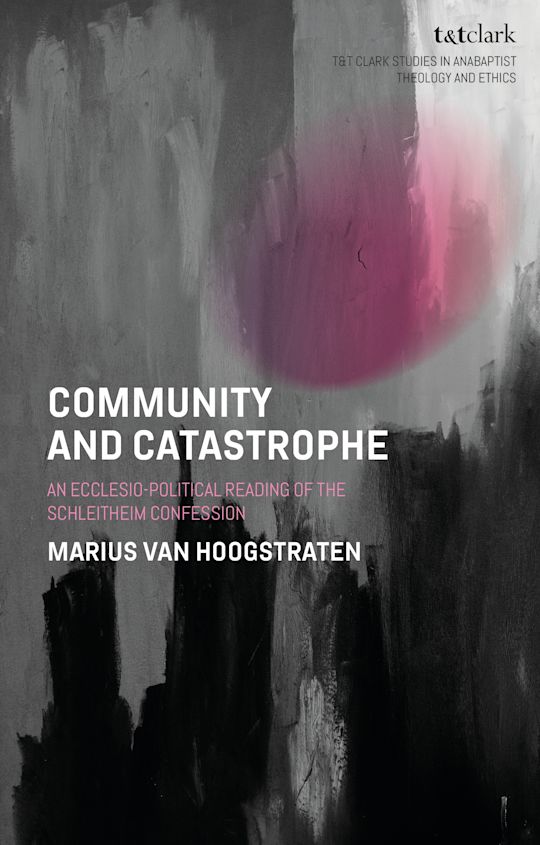
Marius van Hoogstraten’s book Community and Catastrophe provides a reading of an early Anabaptist confession – article by article, in each chapter – where an historical document is run through the sieve of the ecclesio-political. Framed in response to our very present problem of how to live well together in times of crisis, the book is structured by its source material in the Schleitheim Confession, and this allows van Hoogstraten to engage in various critical reframings. The book, at times, is a critique of progress, a refusal to use violence to secure the future, a criticism of those who respond to emergency with exception (to use Carl Schmitt’s language against itself), and it could have been called “after hope” given how it reframes our expectations of a future wherein all tensions are resolved.
Here is a brief overview of its chapters to orient those who have not read it yet (we can’t all be as lucky as I was, to get the last copy of this book, and Jamie’s Organizing Spirit, at the Bloomsbury booth at the AAR meetings in Boston a few weeks ago).
As I walk through this brief summary, I invite you to have the confession in front of you.
- Concerning article 1: van Hoogstraten reframes Anabaptist baptism as a renewal of collaboration between humanity and God, rather than a cut or radical break that might leave behind all that was before it. In short, baptism rejuvenates something ongoing rather than severing the old from the new.
- Concerning article 2: The Schleitheim Confession’s intervention on the ban is reinterpreted in ways that emphasize the repetition of practices, rather than the burden of expecting a single event to carry the weight of community. In sum, to live well together we must have repeatable practices and not hierarchical ‘final’ decision.
- Concerning article 3: On breaking bread, van Hoogstraten turns to the question of communal unity, and refigures the social and spiritual bonds that Schleitheim addresses, by showing how the community gathers in face of absence, and with questionable unity. In brief, community is not one, it is always its own multiplicity within a gentler whole that cannot rest on a stable singular presence.
- Concerning article 4: In response to the Schleitheim article on “separation from the world,” we see van Hoogstraten again reorient the reader toward a form of suffering with the world, but where suffering solidarity is still ‘not of the world.’
- Concerning article 5, on the training of pastors, van Hoogstraten draws the distinction between ministerial leadership as authoritative decision and the work of care (and we may also want to draw such distinctions as scholars in this book launch).
- Concerning article 6, on the Sword, we see another essential contrast that marks the whole book: political and legal sovereignty contrasted with and contradicted by a messiah who is not decidedly not sovereign (a distinction that is also foundational for the work of Travis Kroeker, who will be a respondent today).
- Concerning article 7, as well, is an important contrast: this time between the dominionist logic of swearing oaths and truth-telling. Here I quote page 11, “Swearing, the text seems to argue, fundamentally misunderstands the relation between words, things, God, and human beings. God does not lend Godself to the stabilization of political relations of dominion – there is no final word or guarantee, only life lived in repetition: let your words be yes, yes.”
And so it makes sense that van Hoogstraten engages in constructive readings that say yes to a text that many Mennonite theologians have been happy to leave behind. But in a movement of retrieval and speculative reinterpretation, van Hoogstraten carries us from a document that arises from “an illicit gathering at the dawn of modernity” (an “antagonistic contribution”) to our present where community is made, not given; and where nonsovereign community is a place where nothing is resolved but anything can be worked through.
Thank you Marius for this book, and I think we all are looking forward to discussing it.
-Max
 Dr. Maxwell Kennel