
First of all, I want to express my appreciation to all of you who watch this space for updates on my research. My scholarly work has been progressing in interesting ways on a few fronts, and below I will outline some recent and future projects that might be interesting to you – whether you encounter this space for the first time, or are familiar with the writing projects I have been working on.
Postsecular History + Recent Lecture
My interest in the theopolitical strategies that we use to divide and ascribe value to temporal and historical periods continues, and since Postsecular History came out in late 2021, I have been trying to think more carefully about the usabilities and unusabilities of the past (how we are bound to the past, and how the past refuses our desires to use it).
Last week, I gave a faculty forum lecture on these themes at Bluffton University (at the kind invitation of Chalsi Campbell), and I had the chance to connect briefly with Gerald Mast and Jeff Gundy, both of whom have exciting book projects underway (the former on Menno Simons, and the latter on “phantom power”).
My lecture was called “Bound to Remember: 500 Years of Anabaptist Critique,” and it carries forward some of my thinking in “Anabaptism contra Philosophy” (Conrad Grebel Review 40, 2024) and “Anabaptist Critique” (Mennonite Quarterly Review 99, 2025), as well as my afterword to Astrid von Schlachta’s book Anabaptists (Pandora Press, 2024).
The lecture joins others in the Bluffton University Anabaptism at 500 lecture series, and is summarized here, with the full recording available below:
All in all, the lecture gave me some great opportunities to sharpen my thinking about how to present the essays that I will collect in a book project called Mennonite Metaphysics: Social Critique out of the Sources of the Radical Reformation, which is under contract with Cascade’s Theopolitical Visions series.
Ontologies of Violence + Reception
The reception of my book Ontologies of Violence continues to grow, most recently in my friend Paulo Ravecca’s work on the far-right in “Reading the Far-Right Beyond Self-Righteousness. Neoliberalism, Democratic Deficit, and Javier Milei’s Global Leadership” (by Paulo Ravecca, Emiliano Robaina, and Facundo Zannier) published in Lua Nova. Andrew Fiala has also been in some dialogue with my work in his ontological investigations of pacifism, and I recently discussed the book with Vincent Lloyd in an interview on his book Black Dignity, which should be published any day now with Theory, Culture & Society.
My work on violence is also intersecting with accountability in new ways, and I work out some of it in this recent article in the Conrad Grebel Review 41.2 (2023 -published in 2025):
The next step for the project is a Syndicate symposium on the book with responses from Jamie Pitts, Eleanor Craig, Kieran Way, Daniel Shank Cruz, Paul Doerksen, and David Newheiser.
Social Accountability + Forthcoming Book Chapters
Although I left my job at the Arcand Centre at NOSM University back in August of 2024, I remain connected in a few ways, with the projects that are underway there under the auspices of the CREATE Project.
One exciting piece that was just published is: Larche CL, Kennel M, Tackett S, Marsh DC, Cameron E. “Enhancing Social Accountability in Medical Education and Accreditation: A Meeting Report.” Advances in Medical Education Practice. 2025;16:471-476 (Pubmed link). This report comes out of a particularly rich session at the ICAM conference last year, and the publication of our findings would not have been possible without Cynthia Larche.
Looking back, I am pleased that some of my conceptual work on Social Accountability was published in my introduction to a special issue dossier of the Social Innovations Journal; and looking ahead I am excited to have the two following book chapters forthcoming in a field defining collection on Social Accountability in medical education (Social Accountability of Medical Schools: Empowering the Future of Medical Education and Healthcare. Edited by Mohamed Elhassan Abdalla, Mohamed Hassan Taha, and Charles Boelen).
“Empowering Faculty in Socially Accountable Medical Education,” by Maxwell Kennel, Ghislaine Attema, Jyotsna Rimal, Prattama Santoso Utomo, and Nicholas Torres.
“Socially Accountable Research,” by Maxwell Kennel, Kerri Delaney, Jessica Jurgutis, Joseph LeBlanc, Sarah Larkins, Karen Johnston, and Erin Cameron.
Last but not least, I just heard that a co-authored article on Indigenous data sovereignty and health care is in revision, so more on that soon…
Anabaptist and Mennonite Studies Series + Forthcoming Volumes
As I came off the editorial board at Reading Religion last month, I published this brief piece on Four Books in Anabaptist and Mennonite Studies, but there are so many more texts in the area of Anabaptist and Mennonite Studies that have either been published recently, or are in preparation. Over the past few years, I have been editing and curating an academic book series with Pandora Press that has now reached ten volumes, with at least ten more in various stages of development.
- Volume 1. Gary Waite, Anti-Anabaptist Polemics: Dutch Anabaptism and the Devil in England, 1531-1660. Pandora Press, 2023. Order here.
- Volume 2. Edmund Pries, Anabaptist Oath Refusal: Basel, Bern, and Strasbourg, 1525-1538. Pandora Press, 2023. Order here.
- Volume 3. Cornelius J. Dyck, Hans de Ries: A Study in Second Generation Dutch Anabaptism. Introduction by Mary S. Sprunger. Pandora Press, 2023. Order here.
- Volume 4. Linda A. Huebert Hecht, Women in Early Austrian Anabaptism: Their Days, Their Stories. 2nd Edition. Pandora Press, 2023. Order here.
- Volume 5. J. Lawrence Burkholder, Mennonite Ethics: From Isolation to Engagement. 2nd Edition. Edited by Lauren Friesen. Pandora Press, 2023. Order here.
- Volume 6. The Anabaptist Lodestar: Interpretations of Anabaptism on the Eve of a 500-Year Celebration. Edited and Translated by Leonard Gross. Pandora Press, 2024. Order here.
- Volume 7. James M. Stayer, Anabaptism, Radicalism, and the Reformation: Collected Essays. Edited by Geoffrey Dipple, Sharon Judd, and Michael Driedger. Pandora Press, 2024. Order here.
- Volume 8. “Elisabeth’s Manly Courage”: Testimonials and Songs of Martyred Anabaptist Women in the Low Countries. Edited and Translated by Hermina Joldersma and Louis Grijp. Reprint of the 2001 original with a new preface by Christina Moss. Pandora Press, 2024. Order here.
- Volume 9. Thomas Kaufmann, The Anabaptists: From the Radical Reformers to the Baptists. Translated by Christina Moss. Edited by Maxwell Kennel. Pandora Press, 2024. Order here.
- Volume 10. Astrid von Schlachta, Anabaptists: From the Reformation to the 21st Century. Translated by Victor Thiessen. Edited by Maxwell Kennel. Pandora Press, 2024. Order here.
The last two volumes are particularly important to me, as I was both the series editor and translation editor for both. I think it is fair to say that Astrid’s textbook and Thomas’s brief intervention are essential new works in Anabaptist history, and it is a great honor to have them in the series.
Future titles in the series include a translation of a 650 page biography of Hans Hut, a translation of Friedrich Dürrenmatt’s play Die Wiedertäufer, a book on Dutch Mennonites and art, a collection of essays on Anabaptist women, and many more.
Other books apart from this series also continue to inspire me, from Lauren Friesen’s Theatre, Peace, Justice (just reviewed in Direction: “a serious work of profound scholarship”!), to David Driedger’s forthcoming book Nothing Will Save Us: A Theology of Immeasurable Life (Pandora Press, New Anabaptist and Mennonite Theologies Series, vol. 1) and Pedro A. Sandin-Fremaint’s forthcoming book Hello, Stranger: Thresholds of the Unfamiliar (Pandora Poetics Series, vol. 1).
Critique of Conspiracism + AAR
I am also quite fortunate to be a Senior Research Fellow at the Canadian Institute of Far-Right Studies, where I am workshopping my postdoctoral book, Critique of Conspiracism, outlined below:
What is the relationship between conspiratorial thinking and critique? How do conspiracy theories – albeit in distorted and blindered ways – mirror the hermeneutics of suspicion found elsewhere in critical theory and critical thinking? How can conspiracism as an all-encompassing epistemology be challenged and resisted without the simplistic use of forcible critique against another version of itself, and without false equivocations between conspiracism and critique?
Critique of Conspiracism provides a detailed treatment of these questions without ceding ground to the oversimplifications of conspiratorial thinking and without taking up a patronizing distance from the very human desire to see the world in conspiratorial terms. In three chapters, this study argues that only by combining insights from three discourses and paradigms – Critical Theory, Political Theology, and Internal Family Systems – can conspiracism be successfully critiqued without falling into the numerous epistemological deadlocks that characterize this social pathology.
Intervening simultaneously in the domains of reason (using contemporary critical theories in the tradition of the Frankfurt School), religion (using the scholarly study of religion and critical forms of political theology), and therapy (using the modality of Internal Family Systems), Critique of Conspiracism provides concrete suggestions for responding to conspiracy theorists that avoid the pitfalls of withdrawal into moral abstinence and the use of persuasive force in debunking.
As I continue work on the book in 2025, I am planning a series of workshops on the project for CIFRS this Spring, and I am looking ahead to presenting on it at the American Academy of Religion Meetings in Boston this November. The presentation will be in the Ecclesiological Investigations unit, and it is called “Conspiracism as Political Theology: Project 2025 and Ecclesiologies of Conspiracy.”
Pastoral Power
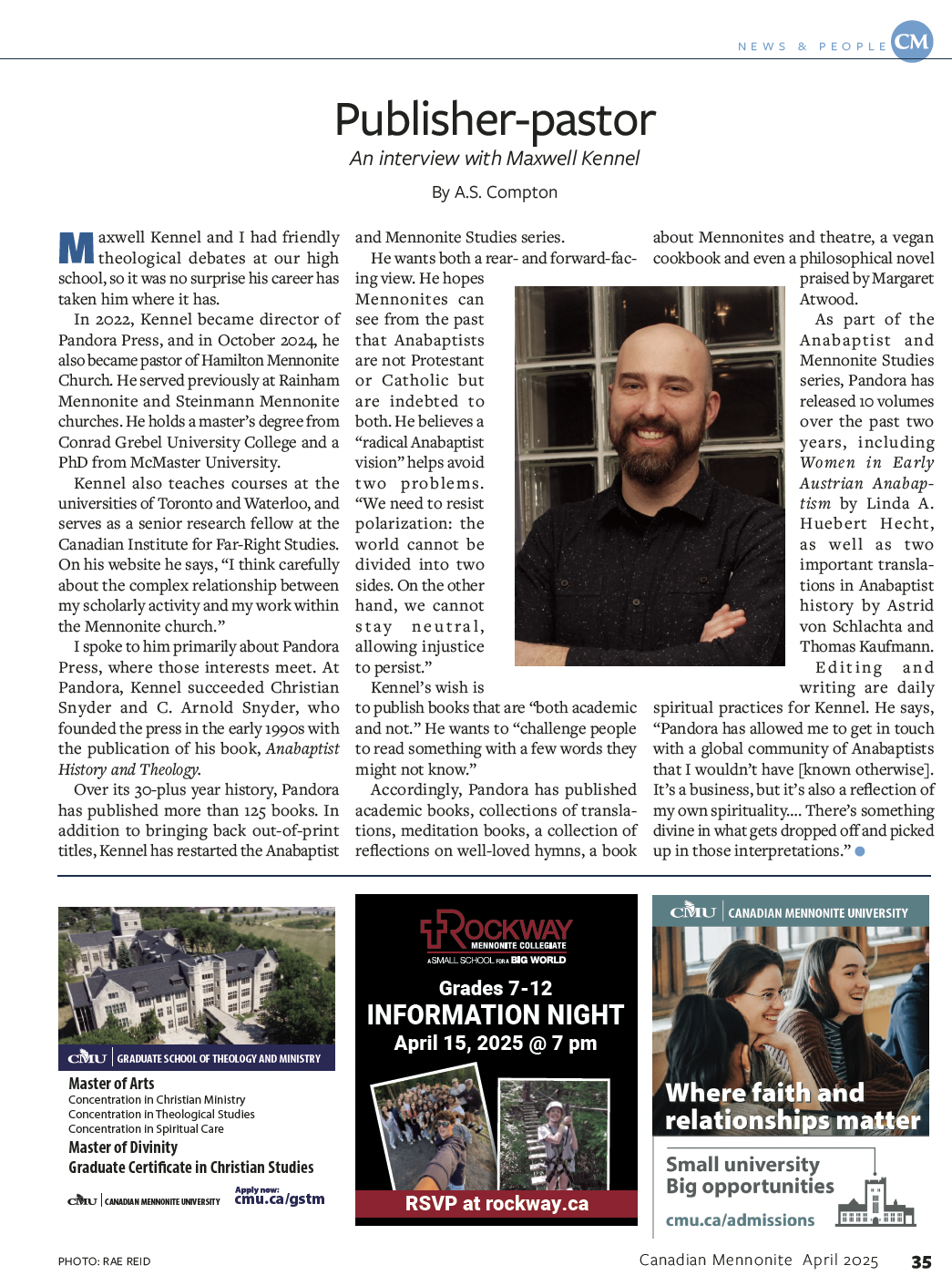
Amidst all of these new projects, I have returned to full time ministry – that complex site of what Foucault calls “pastoral power.” Although the interview focuses on my publishing work, my ministry work is thankfully my full-time focus, and I have already found it to be a consistent, supportive, valuable, and enjoyable environment for life and work.
As I contemplate the relationship between my new congregational context and my scholarship, I have been aided by others who are also navigating between the demands of scholarly rigor and the existential life of congregational ministry – a “between” that is always a complex and contextual mediation between normative and descriptive claims, and between flexibilities and commitments.
It is good to have a place to do this work, and a community of people to connect with at the Hamilton Mennonite Church who have such enriching and subtle approaches to their faith and life, especially as the heirs of the Radical Reformation continue in their resistance to war and violence, near and far.
Always more soon,
-Max
 Dr. Maxwell Kennel