

Social Accountability and Health Equity
Maxwell Kennel
Dr. Gilles Arcand Centre’s Equity-Oriented Training Research Series, Summer 2024.
As many of us in this context know, and as Alex has just shown, Social Accountability is a health policy strategy that concerns the obligations that medical professionals and institutions have to the society and specific communities they serve. Social Accountability is a concept with a history, initially developed by Charles Boelen and his colleagues in a series of documents for the World Health Organization in the early 1990s that are available online, and fascinating to read.
Since then Social Accountability has become an influential, and international, force for change in health professions education, and I have had the privilege of studying Social Accountability in this research center over the past two years as a social theorist observing and engaging in the world of medical education. In that time, I have come to see “Social Accountability” as a keyword that names something much broader than we often think.
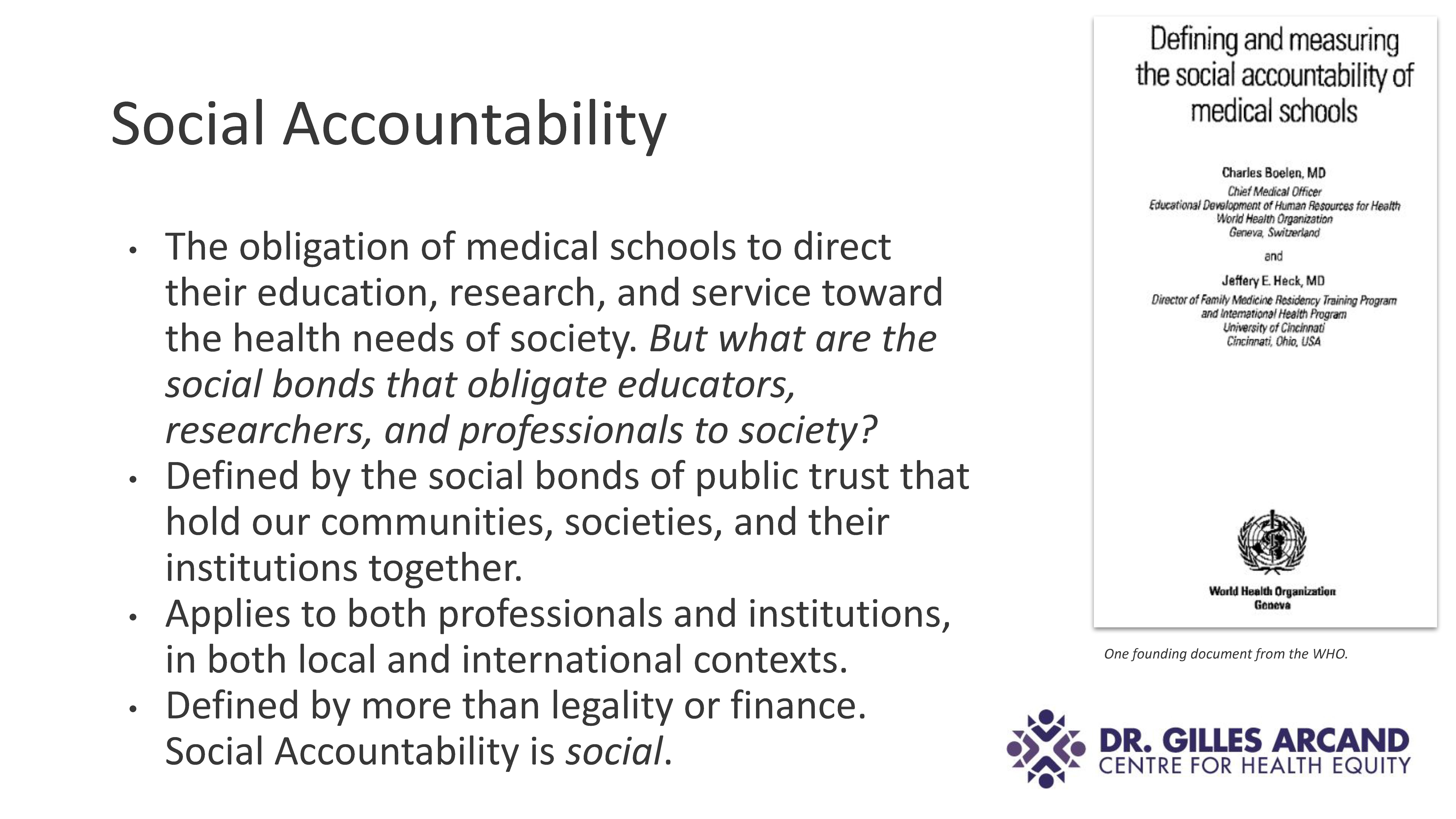
I argue that Social Accountability is a name for the social bonds of public trust that hold our communities, societies, and their institutions together. Without bonds of trust between professionals, institutions, and societies, we would never expect medical schools to “direct their education, research and service activities towards addressing the priority health concerns” of their contexts.
Now, you may notice that “Social Accountability” is a term with a broad semantic range, applying at once to individual physicians who want to respond well to their patients and communities, all the way up to institutions like hospitals or medical schools that develop policies to connect their work with the health needs of society.
Social Accountability is all about how health professionals and institutions develop feedback loops that keep them accountable to the society they are tasked to serve. This means that Social Accountability is defined by the bonds that hold institutions and society together. Some researchers think that these bonds are defined by legal and financial contracts, which is true in a limited sense. But a more enriching way of thinking about Social Accountability than simply in terms of law or money, is as a social bond that obliges professionals and institutions to respond with care and service to society because their professions are about making our societies better, more healthy, and more just.
And this becomes all the more complex when we consider the other two key themes we’re here to discuss today: equity and research. I’ll start with the relationship between Social Accountability and health equity, and then discuss how they both can influence our research practices and skills.
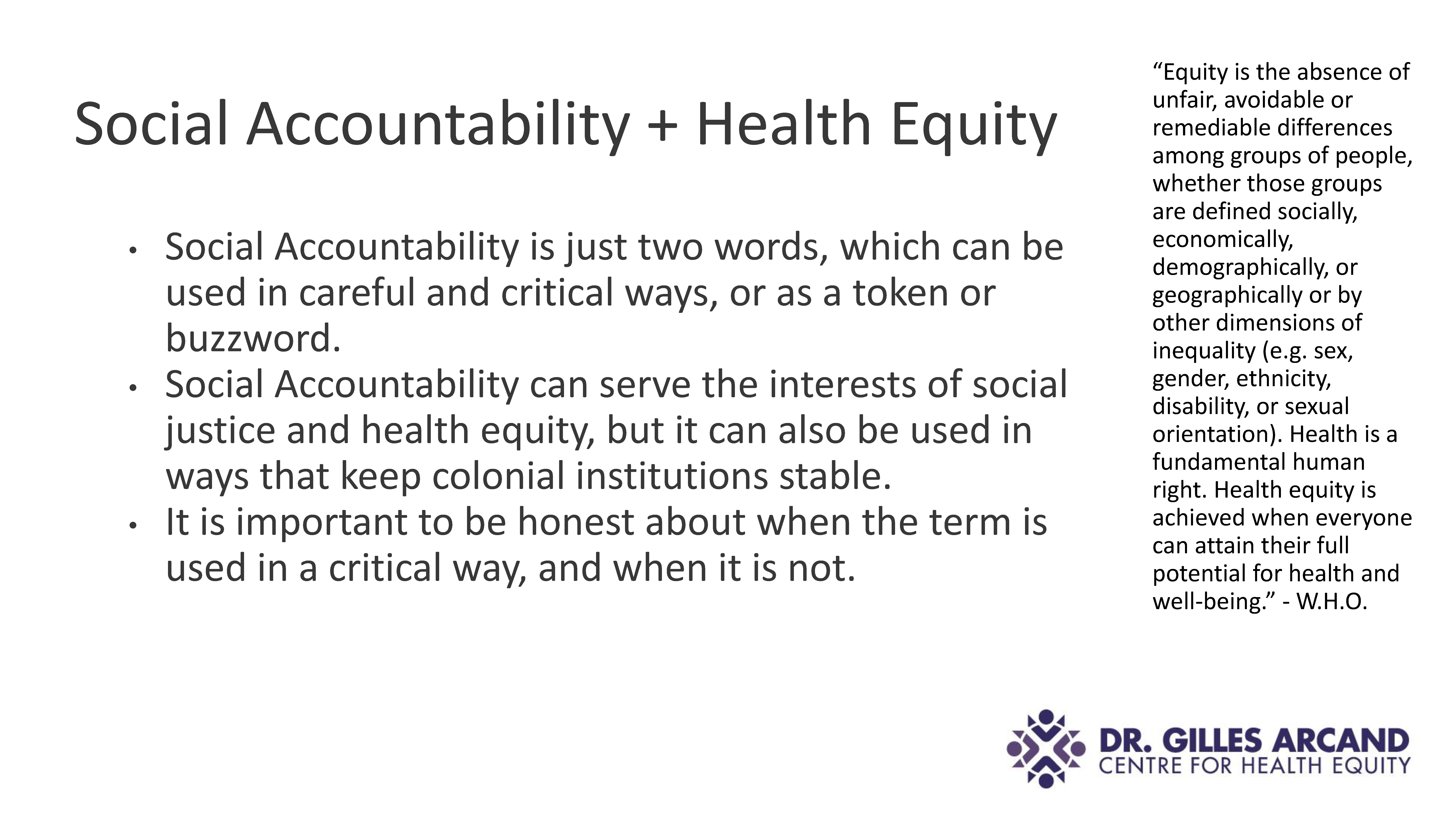
Social Accountability has a complex relationship with equity, social justice, and related values like antiracism, diversity, inclusion, and decolonization. There is an important debate currently going on underneath the surface of the discourse on Social Accountability, with some thinkers insisting that Social Accountability inherently serves the interests of equity and social justice, and others rightly pointing out that the term “Social Accountability” – historically and presently – serves the interests of colonial institutions, often becoming tokenistic and dismissive, allowing people to avoid the difficult work of divestment from colonial power.
I do not claim that Social Accountability is inherently for or against the aims of equity and social justice. Social Accountability is just two words, and like any other term it can be used in a number of different ways, including to further the cause of justice and equity, and to represent the opposite.
This brings us to an essential distinction for research that I hope you will take with you. When I teach in the Humanities and Social Sciences, this is the one key distinction I try to leave all of my students with, both because it is so difficult to make, and because it is so important, and it is the distinction between normativity and description.
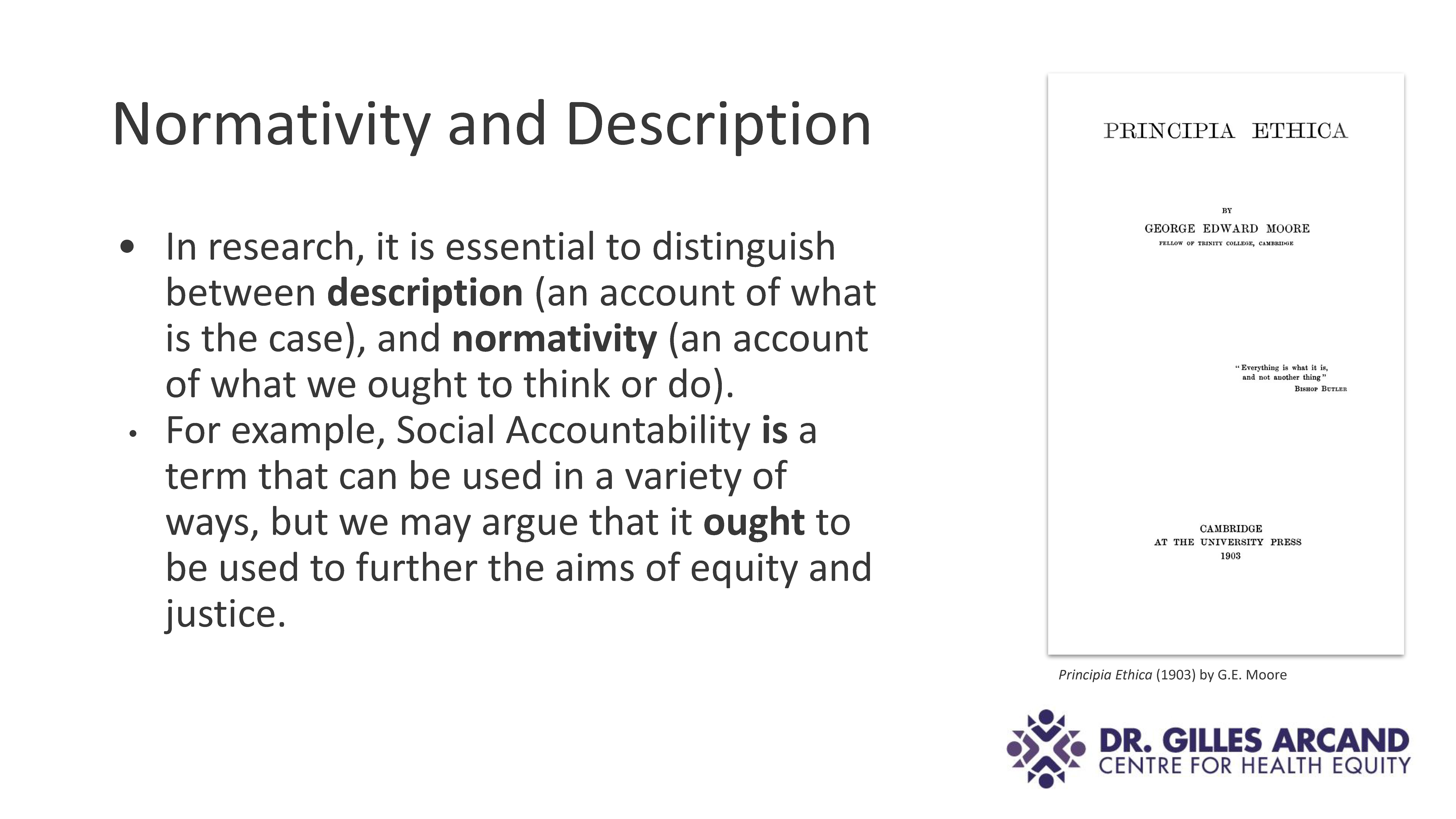
This distinction has its origins in the moral philosophy of G.E. Moore, but it goes well beyond his work and has been taken up by critical theorists like Rainer Forst, with great effect.
In research, as in the discourse on Social Accountability, it is essential to distinguish between descriptive and normative approaches. Description is an account of what is the case, and normativity or prescription provide accounts of what should be, what ought to be, and what we aspire toward.
It is descriptively true that the term “Social Accountability” is used in ways that both promote and also inhibit the pursuit of equity. Descriptive work concerns what is the case – how things are. We can describe all of the ways that the term “Social Accountability” is used, and show where and when it is used in relation to social justice and equity.
By contrast, some research and work in our field is normative: it does not tell us what is the case; it insists on what should be the case. Social Accountability itself is a normative concept because it argues for how medical education should be improved. Social Accountability is a norm that we here at the Arcand Centre are trying to critique, refine, and (in a precise sense) advance and promote. This is because many of us believe that Social Accountability – when it is done well – can provide a future for medical education that better connects health professionals and institutions with society, in the interests of equity, social justice, antiracism, decolonization, and other efforts toward a more well and just society.
But this project of both descriptively studying and normatively advancing Social Accountability requires clarity and honesty about where the term helps and works, and where it falls short and must be critiqued and revised. Studying and advancing Social Accountability requires us to distinguish between the descriptive and normative angles of approach that we take, and it requires us to develop an essential research skill: being self-reflective, self-aware, and self-reflexive, and most of all – using the term “Social Accountability” in a socially accountable way.
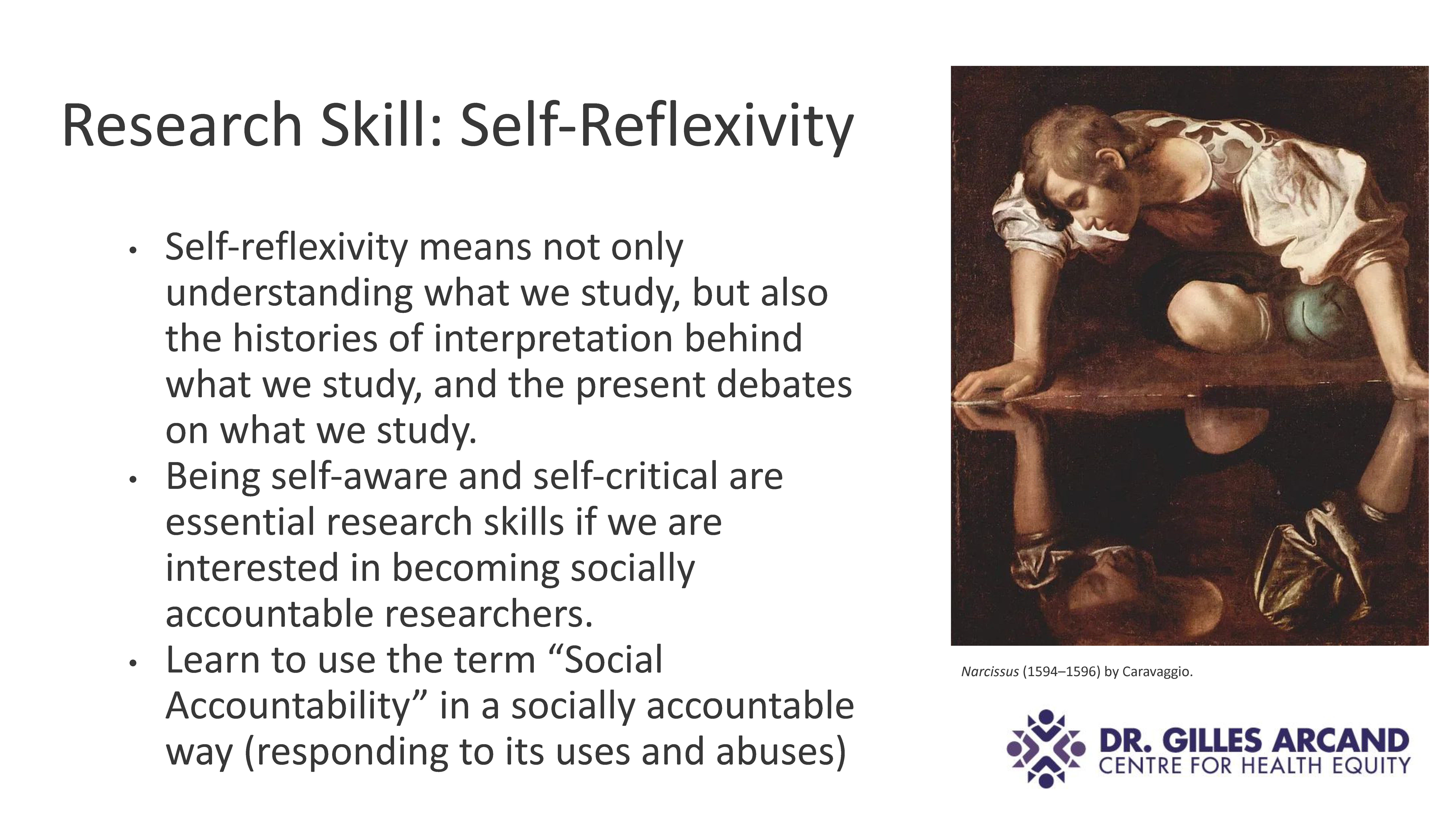
Self-reflexivity means understanding not only the terms that we use and the things that we study, but also their histories and the fact that we all approach them differently. My ideas about Social Accountability won’t be identical to yours, and self-reflexivity is important in the process of dialoguing about the fact that we do not all agree and are not all the same. I don’t assume that we share the same understanding of the topic and the term, but we can still work together, have meaningful discussion and debate, and learn from each other across our academic and professional networks.
I am part of a SSHRC Partnership Project called “The CREATE Project,” which is currently trying to develop a socially accountable research network, and one of our key questions is: what makes research socially accountable? We know a lot in the discourse about what makes doctors and medical schools socially accountable, but the question of what makes our research activities socially accountable has not been explored in as much detail – which is an absence that our project aims to remedy.
One thing that we are learning in this project is how important it is to recognize that there are many veins of research beyond the world of medical education and social accountability that concern themselves with undertaking research in a good way, from Indigenous research methods to Community based participatory research (CBPR). Our project is focused how we can bring the conversation on Social Accountability to the world of research through the formation of a research network, and how we can connect with researchers who are already undertaking this work, but who use different terms than we do, all without trying to position our way of doing things as the only way. There are many paths to our shared goals of equity and justice, and Social Accountability is one of them.
So I will conclude with some provisional answers to the question we are here to consider: What makes research socially accountable? How does this relate to equity?
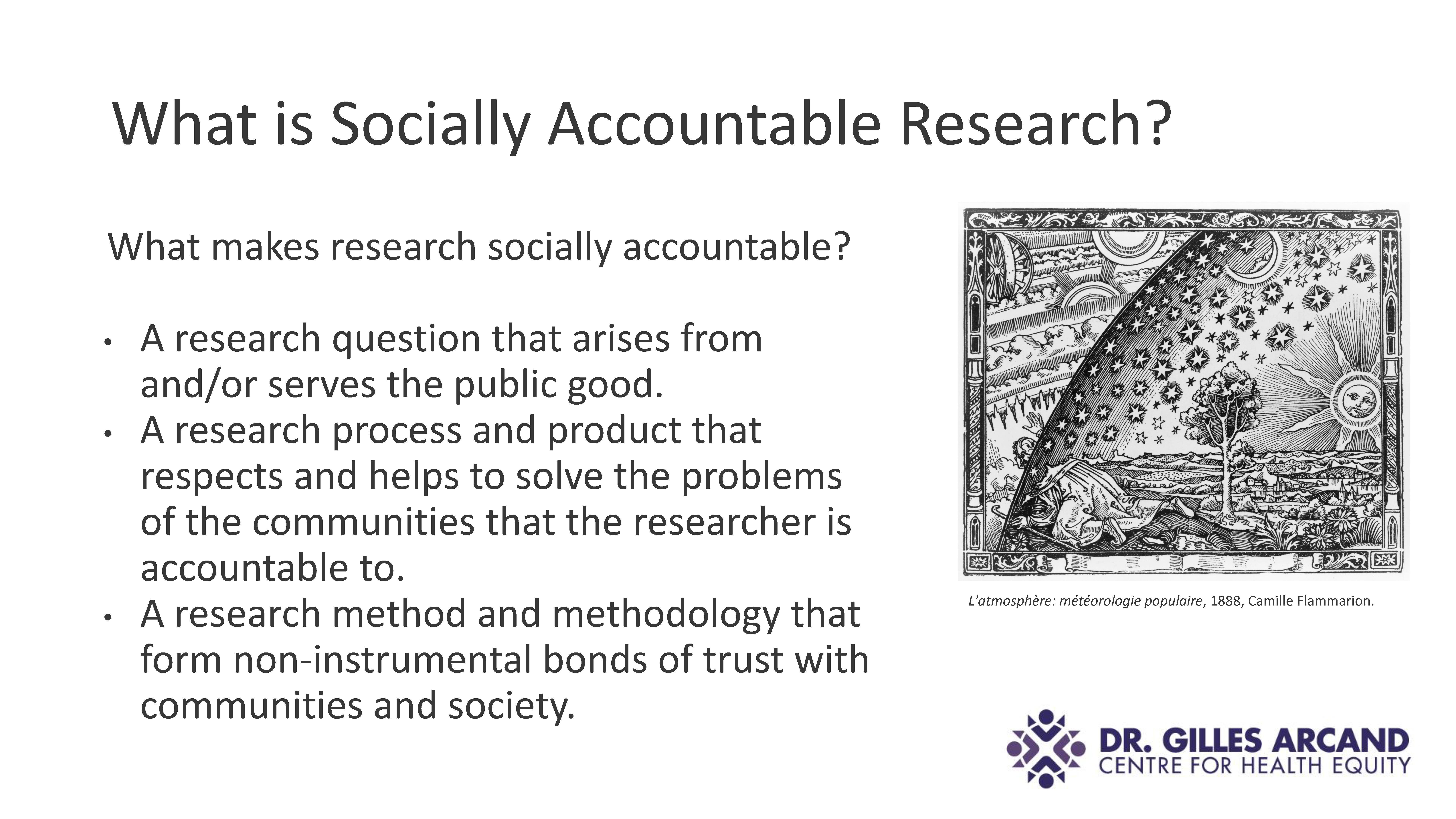
I would suggest that, just like professionals and institutions, socially accountable researchers should be interested in forming social bonds of trust between themselves and the communities they serve. This means moving beyond a restrictive focus on academic freedom (where I the researcher choose my own questions, regardless of the public good), and toward the task of answering the research questions that my community has identified and the research questions that will actually benefit the communities I serve.
This means trusting that the communities that researchers are tasked to serve (especially when they are publicly funded) will always know something about what problems they need help solving from those researchers who are paid by their tax dollars.
So, socially accountable research begins with the selection of a research question that follows the cues of actually existing communities that have a social bond of trust with the researchers that their public institutions support. If those bonds between researchers and communities are not well-formed, then it is the job of the researcher to start the trust-building process with their constituencies, in a non-instrumental way that moves beyond treating communities and their representatives as hurdles to jump over or boxes to check, and begins to see them as long term partners in the research process who should eventually receive insights and solutions to their self-identified problems.
Once you have identified or co-identified a research problem to be addressed or question to be answered, the next step is to consider who exactly your research affects and helps. What social benefit does your research bring? This question may be quite a ways downstream, but it should always be answerable.
Once your research question is formed in a way that reflects the intersection of your expertise, interests, and the concrete needs of the community you are tasked to serve, then the next step is to make sure that both the process and the product of your research are of service to society, and connected to that society in a meaningful way, such that you could be held to account.
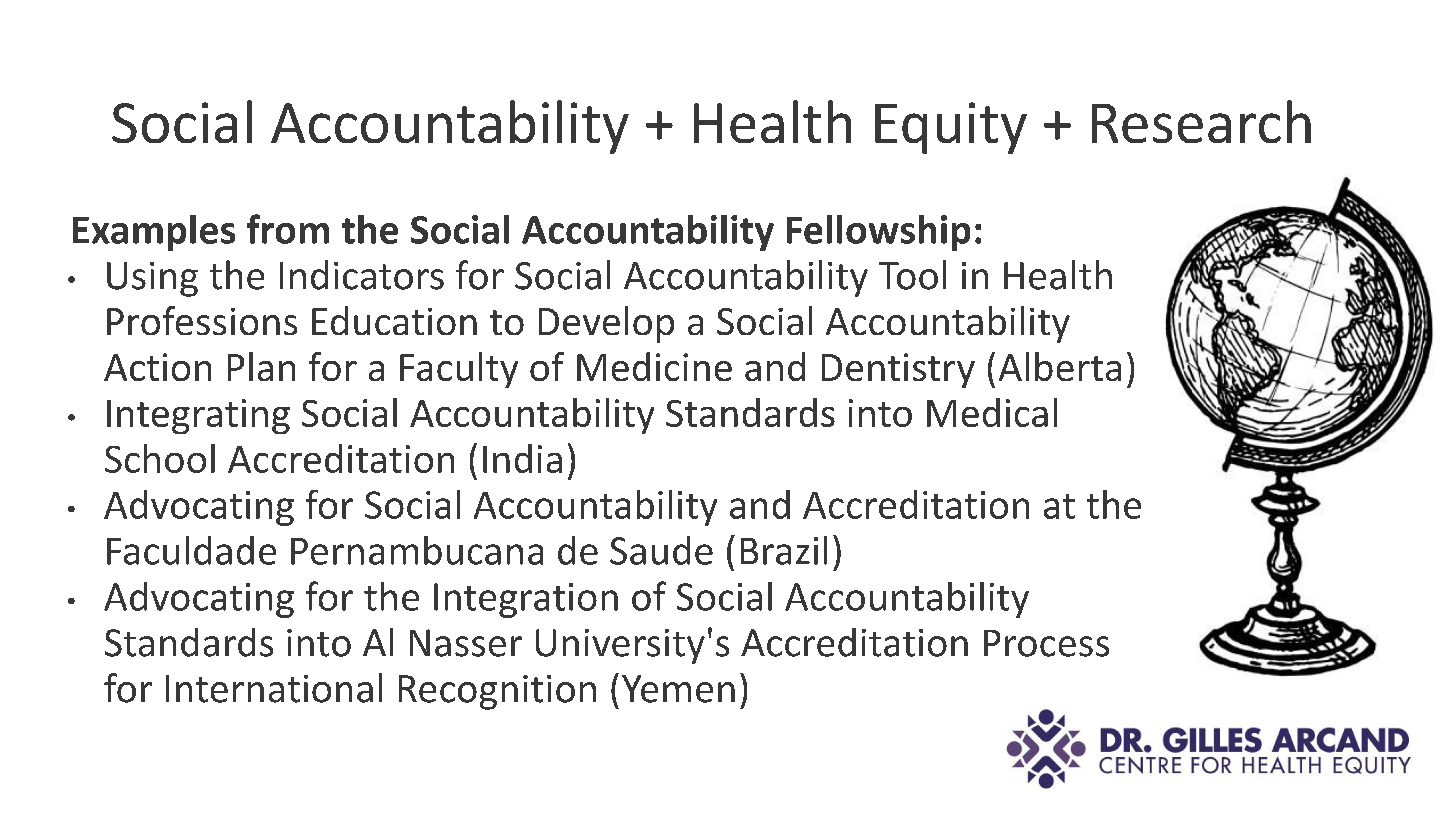
I’ll conclude with an example of this in the international context. I’ve just concluded organizing the first year of the Social Accountability Fellowship – an international fellowship program for deans of medical schools around the world, who gather under the auspices of NOSM University, the Arcand Centre, and The Network: Towards Unity for Health, to learn how to bring their institutions closer to the aims of Social Accountability. I’m currently editing the policy papers that several of our fellows have submitted to be published in a special issue of the Social Innovations Journal, and these papers are excellent examples of socially accountable research.
Each policy paper takes their research question from their own specific context – Pakistan, Yemen, India, Alberta, South Africa – and they include significant research describing the health needs of the communities their institutions are tasked to serve. But then, they move a step further, beyond simply describing the problems they face, toward engaging in policy advocacy in their institutions and governments. One paper advocates for embedding Social Accountability as an accreditation standard in the government of the author’s country; another gives a rationale for reforming a program at a medical school; and another puts forward evidence-based programs for community engagement in rural areas.
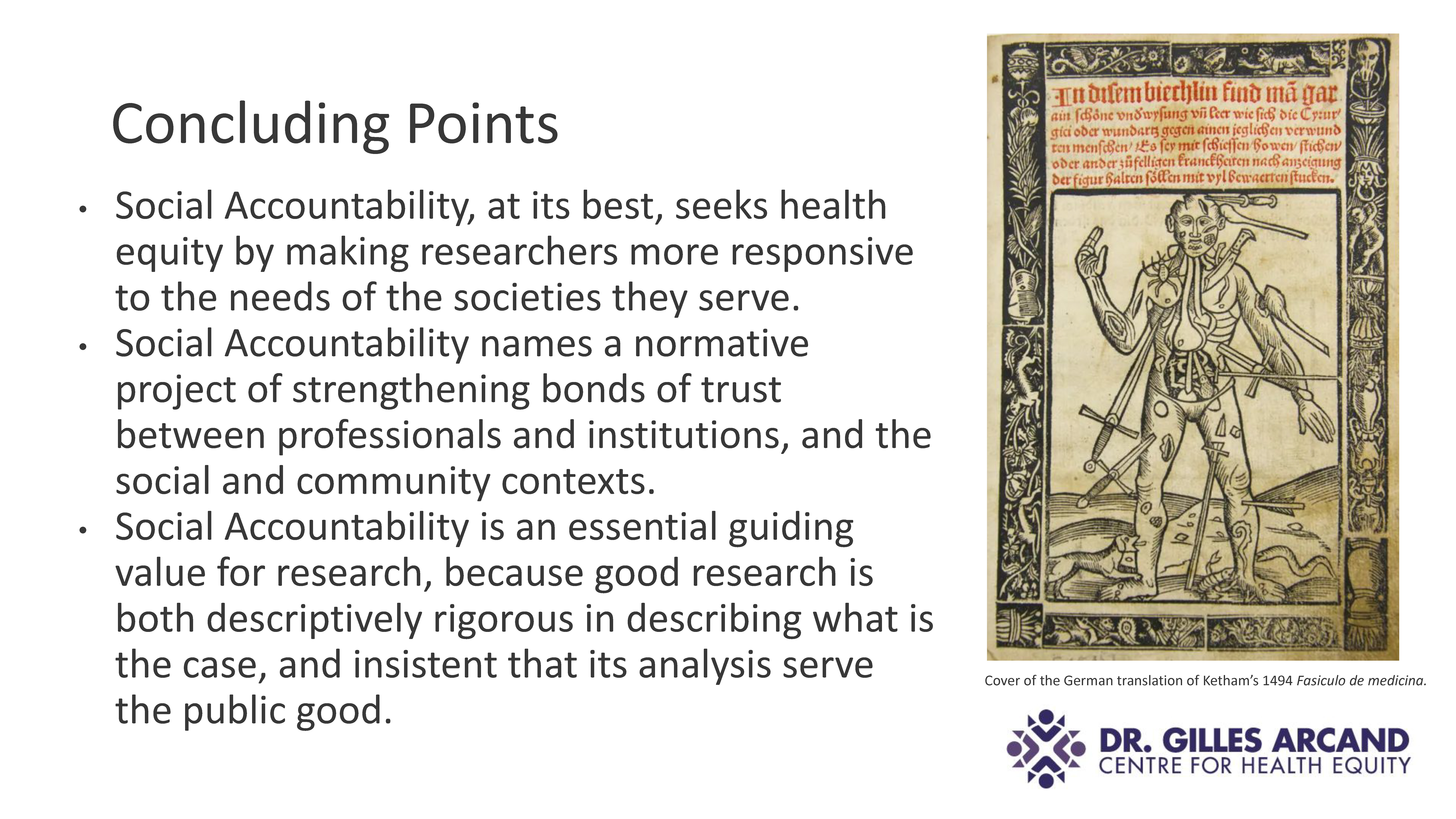
Social Accountability, at its best, seeks health equity by making researchers more responsive to the needs of the societies they serve – an end result that results in more equitable and just outcomes. Social Accountability names a normative project of strengthening bonds of trust between professionals and institutions, and the social and community contexts. And Social Accountability is an essential guiding value for research, because good research is both descriptively rigorous in describing what is the case, and insistent that its analysis serve the public good.
 Dr. Maxwell Kennel